
Your brain isn't a problem to be fixed.
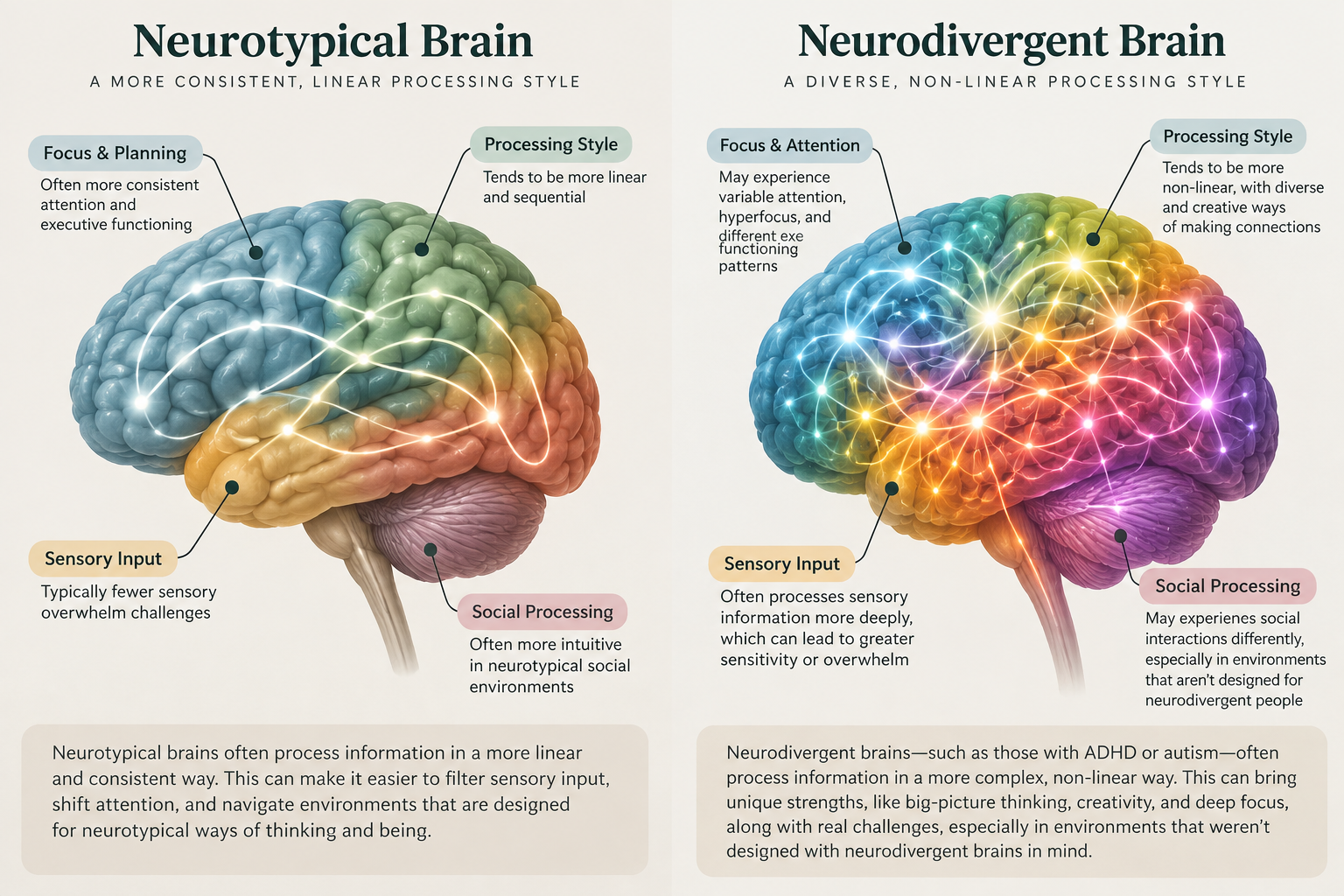
Neurodivergence-affirming therapy starts from a pretty simple idea: different brains work differently. ADHD and autism can create very real challenges, especially in environments that weren't designed with neurodivergent people in mind, but the goal of therapy isn't to make you better at pretending to be neurotypical.
Maybe you've known you're neurodivergent for years. Maybe you're newly diagnosed. Maybe you've spent half your life wondering why things that seem easy for everyone else require an unreasonable amount of effort from you.
Or maybe you're here because you're starting to wonder whether ADHD or autism could explain parts of your experience that never quite made sense before.
You don't need a diagnosis to belong here.
I work with neurodivergent adults at different points in the process, including people who are formally diagnosed, self-identified, questioning, or seeking assessment for ADHD or autism.
For some people, the work is about understanding how their brain works and building a life that fits it better. For others, it's about finally having a name for patterns they've spent years interpreting as laziness, failure, being “too sensitive,” being “too much,” or simply not trying hard enough.
And sometimes it's both.
What does neurodivergence-affirming actually mean?
“Neurodivergence-affirming” gets used a lot, and sometimes it seems to mean little more than putting the word affirming on a website.
For me, it means we aren't starting with the assumption that the goal is to make you look, communicate, work, socialize, regulate, or function more like a neurotypical person.
It means getting curious about how your brain works: what helps, what overwhelms you, what takes more energy than other people realize, what you've learned to hide, and what you've been blaming yourself for because nobody ever explained that your brain might simply be doing things differently.
We're not trying to make you better at masking.
That might mean exploring executive functioning, sensory needs, communication, emotional regulation, routines, relationships, burnout, attention, motivation, or the enormous amount of energy it can take to appear “fine.”
Sometimes therapy involves finding strategies that make life easier. Sometimes it involves accommodations. Sometimes it's recognizing that the system you're using keeps failing because it was designed for somebody else's brain.
And sometimes the work is grieving how long you believed you were the problem.
Strengths and struggles can exist at the same time.
An affirming approach doesn't mean pretending ADHD or autism never make life difficult. Executive dysfunction is real. Sensory overwhelm is real. Burnout, communication differences, task initiation, transitions, emotional intensity, and navigating environments that don't fit your needs can be genuinely hard.
We can work with those challenges without treating your neurodivergence itself as something that needs to be cured.
Adult ADHD & Autism Assessment
Sometimes people come to me already pretty certain they're neurodivergent. Others arrive with a lifetime of experiences that never quite added up and a growing suspicion that ADHD, autism, or both might be part of the picture.
My adult ADHD and autism assessment process is neurodiversity-affirming and looks at more than whether you score above a cutoff on a questionnaire. We explore your current experiences, strengths, developmental history, daily functioning, environment, and the ways you may have learned to adapt, compensate, or mask over time.
Why assess ADHD and autism together?
ADHD and autism are different neurodevelopmental conditions, but they can occur together and can overlap in areas like executive functioning, attention regulation, emotional regulation, social communication, sensory processing, routines, adaptive functioning, and relationships.
In adults, the picture can become even more complicated when masking, compensation, trauma, anxiety, and years of learned coping strategies are involved. Looking at both helps us avoid assuming every experience has the same explanation or overlooking one because another seems more obvious.
Assessment isn't about trying to prove you're neurodivergent.
The goal is to understand the whole picture as accurately as we can. Findings may be consistent with ADHD, autism, both, neither, or suggest that additional evaluation would be helpful.
A questionnaire score by itself isn't a diagnosis. Your results are considered alongside your developmental history, functional impact, clinical interview, and the other information available to us.
What does the assessment actually involve?
You won't walk in, take one test, and walk out with a label. Adult ADHD and autism assessment is a process of putting multiple pieces of information together and looking for patterns across your life.
The exact measures I use are individualized, so not everyone completes the same assessment packet. We choose what makes sense based on what you're experiencing and what we're trying to understand.
The process may include:
Clinical interview about your current concerns, strengths, and daily functioning
Developmental history, including childhood and adulthood
ADHD and executive functioning measures
Autism and autistic-trait measures
Exploration of masking and camouflaging
Sensory and repetitive-behavior experiences
Functional impact across work, relationships, self-care, and daily life
Consideration of things like trauma and social anxiety when they may overlap with or complicate the picture
What about childhood records or a parent interview?
Developmental history matters because ADHD and autism are neurodevelopmental conditions, but I also understand that not every adult has access to childhood records or a parent who can participate.
When appropriate and with your permission, a partner, parent, family member, or friend may provide collateral information. Not having someone available to do that does not prevent you from being assessed.
Then we put the pieces together.
Once the required forms, interview, and any supporting information are complete, I score and interpret the assessment and prepare a written report. We then meet for a follow-up session to review the results, clinical impressions, limitations, recommendations, referrals, and possible next steps.
If you'd like your report shared with a medical provider or another professional, you can authorize me to send it.
What this assessment is, and what it isn't
This assessment is designed to help us understand whether your developmental history, current experiences, and patterns of functioning are consistent with ADHD, autism, both, neither, or whether additional evaluation may be needed.
It combines clinical interview, developmental and functional history, individualized screening and assessment measures, and other available information rather than relying on a single questionnaire or score.
This is not a comprehensive neuropsychological evaluation.
Neuropsychological evaluations can include specialized cognitive, intellectual, academic, memory, or other performance-based testing that is outside the scope of this service.
Some schools, employers, testing organizations, disability programs, or other institutions may require evaluation or documentation from a psychologist, physician, or another specifically qualified professional. If what you need falls outside the scope of my assessment, I may recommend additional evaluation.
So how do I know if this is what I need?
If your goal is to better understand whether ADHD or autism may explain your experiences, identify patterns of strengths and challenges, and receive clinical impressions and recommendations for next steps, this assessment may be a good place to start.
If you're seeking documentation for a specific accommodation, disability program, school, standardized testing organization, legal matter, or another institution, it's a good idea to find out exactly what type of evaluation and documentation they require before scheduling. Their requirements may be different from what this assessment provides.
If you're not sure, ask.
You don't need to figure out the difference between screening, assessment, diagnosis, and neuropsychological testing on your own. Tell me what you're hoping to get from the assessment and, if applicable, what you need the documentation for. We can determine whether my assessment is an appropriate fit before you invest your time and money in it.
Neurodivergence doesn't stop at your brain.
ADHD and autism can affect much more than attention, organization, or social communication. Neurodivergence can shape how you experience sensation, emotion, movement, time, transitions, relationships, touch, intimacy, and even the signals coming from inside your own body.
You may notice hunger only when you're suddenly starving. You may not realize you're overwhelmed until you've already shut down. Certain sounds, textures, lights, smells, or kinds of touch may feel intensely uncomfortable while other sensations help you regulate. You may need movement to think, pressure to settle, silence to recover, or significantly more time than other people seem to need after being around people.
None of that exists separately from mental health.
Masking can work. Until it really doesn't.
Many neurodivergent adults become incredibly skilled at adapting. You learn the scripts, watch what other people do, force yourself through sensory discomfort, overprepare, overthink, people-please, rehearse conversations, hide stimming, or build elaborate systems just to keep up with things other people seem to do automatically.
Those strategies may have helped you get through school, build a career, maintain relationships, or simply avoid being judged.
They can also be exhausting.
Therapy can be a place to notice where masking and compensation are costing you more than they're helping, without assuming the answer is to stop every coping strategy you've ever developed.
Burnout isn't a character flaw.
Sometimes the system that worked for years suddenly stops working. Tasks become harder. Sensory tolerance drops. Socializing takes more out of you. Executive functioning gets worse. You need more recovery time, but life keeps asking for the same level of output.
Instead of starting with “How do we make you productive again?”, we can get curious about what your brain and body have been carrying, what demands are sustainable, what needs to change, and what support might actually help.
And yes, neurodivergence comes into relationships and sex, too.
Sensory preferences, interoception, communication differences, attention, transitions, rejection sensitivity, demand avoidance, executive functioning, masking, body awareness, and regulation can all influence relationships and sexuality.
That doesn't automatically mean something is wrong with the relationship or your sexual functioning. Sometimes understanding how your nervous system processes connection, touch, expectations, and sensory information changes the entire conversation.
What might we explore in therapy?
Neurodivergence-affirming therapy isn't ADHD coaching or training you to perform neurotypical functioning more successfully. It's psychotherapy that makes room for the ways ADHD, autism, and other parts of your experience may intersect with your mental health, relationships, identity, trauma history, sexuality, and nervous system.
The work depends on what is bringing you to therapy and what you want to understand, process, or change.
You might come in wanting to explore...
Shame or self-criticism connected to being different
A late ADHD or autism diagnosis or identification
Masking and the impact of years spent trying to fit in
Neurodivergent burnout and emotional overwhelm
Anxiety, depression, grief, or trauma alongside neurodivergence
Sensory experiences and their impact on emotional well-being
Or how neurodivergence shows up in...
Identity and your understanding of yourself
Relationships and attachment
Communication and conflict
Boundaries and people-pleasing
Sexuality, desire, intimacy, and touch
Body awareness and nervous-system responses
Self-advocacy and communicating your needs
Understanding comes before changing.
Sometimes learning that you're neurodivergent changes the meaning of experiences you've carried for years. Things you understood as personal failures may look very different when viewed through the context of neurodivergence, trauma, environment, sensory experience, and the ways you've learned to adapt.
Therapy gives us room to explore those experiences without turning every difficulty into a skill deficit that needs to be corrected.
You don't need to already know whether you're neurodivergent, have a formal diagnosis, or be able to neatly separate ADHD, autism, trauma, anxiety, relationships, and everything else happening in your life.
You may be looking for therapy that understands neurodivergence as part of who you are. You may be questioning whether ADHD or autism fits your experience and want a more structured assessment. Or you may already know you're neurodivergent and simply want a therapist who doesn't require you to explain or defend that before the actual therapy can begin.
Is neurodivergence-affirming therapy or assessment right for me?
Explore whether ADHD, autism, or both may fit your experience
Better understand a recent or late identification
Explore masking, burnout, shame, or the impact of feeling different
Understand how neurodivergence intersects with trauma or mental health
This might be a good fit if you want to...
Explore neurodivergence within relationships or attachment
Talk openly about neurodivergence, sexuality, touch, or intimacy
Better understand sensory and body-based experiences
Work with a therapist who approaches neurodivergence from an affirming rather than deficit-based perspective
You don't have to know which door you're walking through yet.
If you're unsure whether you're looking for assessment, therapy, or some combination of the two, that's okay. We can talk about what you're hoping to understand or change and determine which service, if either, makes sense.
Neurodivergence & assessment at SOMA
Services: Neurodivergence-affirming psychotherapy and combined adult ADHD and autism screening assessment
Who I work with: Adults 18+
Location: In person in Elizabeth City, North Carolina
Telehealth: Available across North Carolina and Virginia
Assessment approach: Integrative and neurodiversity-affirming, considering developmental history, current functioning, strengths, environment, masking and compensation, clinical interview, individualized measures, and collateral information when available.
Assessment report: Includes scoring and interpretation of assessment results and a written report, followed by a session to review clinical impressions, limitations, recommendations, referrals, and possible next steps.
Provider:
Britney L. Dixon, MS, LCMHC, LPC, CST, CCTP-II, CASDCS, ADHD-CCSP
Wondering whether therapy or assessment is the right place to start?
You don't have to figure that out before reaching out. A free 15-minute consultation gives us a chance to talk briefly about what you're looking for, whether you're interested in neurodivergence-affirming therapy, adult ADHD and autism assessment, or you're not quite sure yet.
If my services aren't the right fit for what you need, including if you need a type of testing or evaluation I don't provide, I'll tell you that too.