
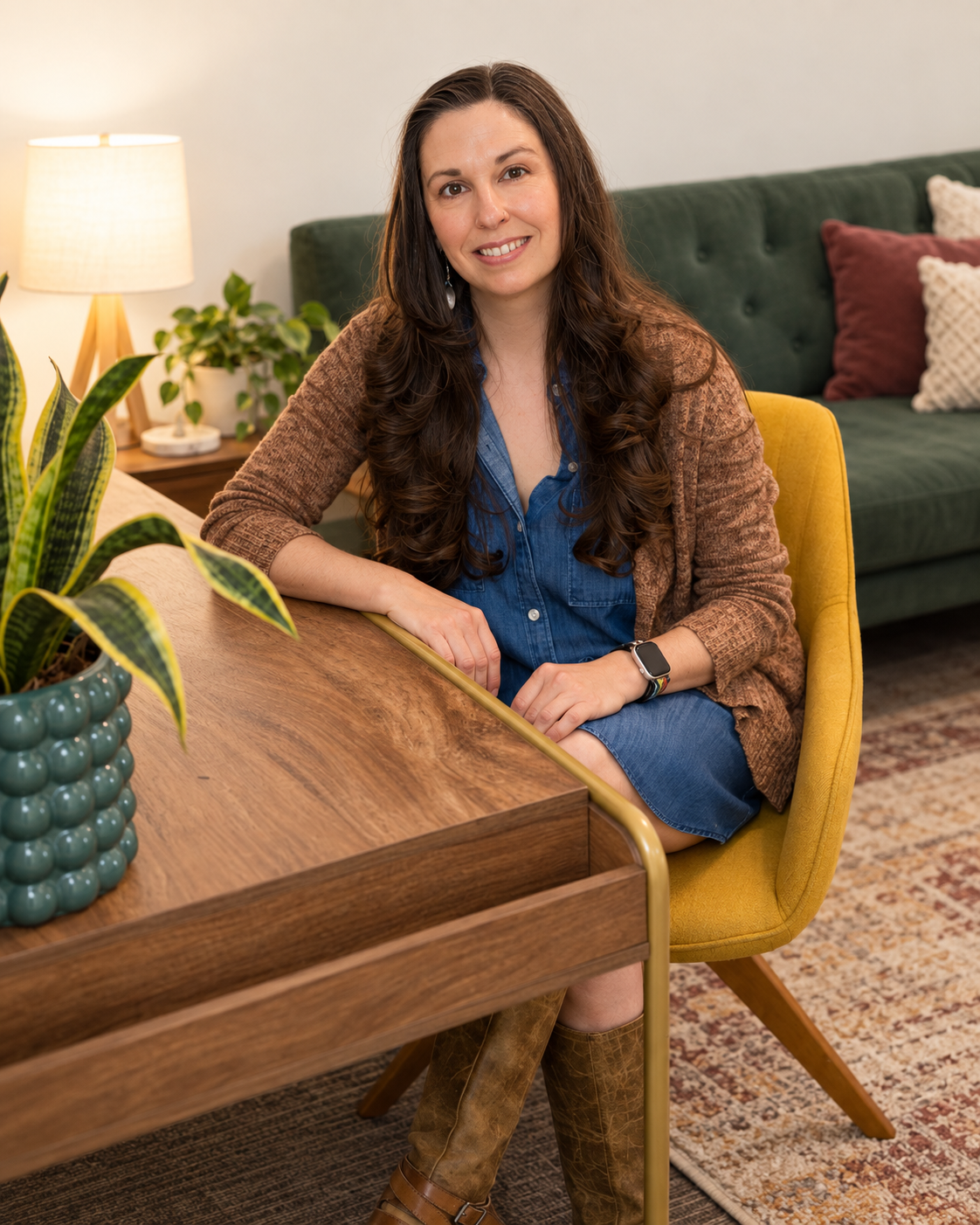
I'm Britney. And I'm probably not what you picture when you think “therapist.”
I'm Britney Dixon, a trauma therapist, AASECT Certified Sex Therapist, and the person behind SOMA.
I'm direct, curious, solidly in the ADHD category, and occasionally equipped with morbid humor. I don't believe therapy requires a perfectly neutral face, carefully polished language, or pretending we're not two actual humans sitting in a room together.
My clients tend to find me because they're tired of editing themselves in therapy. Maybe their trauma and sexuality overlap. Maybe they're neurodivergent. Maybe their relationships don't fit neatly into the boxes they've encountered elsewhere. Maybe they've done therapy before and understand themselves really well, but their body still hasn't gotten the message.
You don't have to make yourself easier to understand here.
You can swear. You can laugh at something objectively terrible because that's how you cope. You can lose your train of thought halfway through a sentence. You can tell me something is weird, awkward, embarrassing, or hard to say.
You don't have to perform being a “good client.” I would much rather work with the person who actually showed up.
Why SOMA?
Soma means body. I chose the name because so much of what brings people to therapy isn't happening only in their thoughts.
You can logically know you're safe and still feel your body brace. You can understand why you respond a certain way and still find yourself doing it. You can love and trust someone and still have your nervous system respond to intimacy as though something isn't safe. Insight matters, but sometimes knowing why isn't enough to change what happens next.
That's why my work pays attention to the whole person: thoughts, emotions, relationships, sexuality, lived experience, and the body that has been carrying all of it.
I wanted to build the kind of practice I would actually want to walk into.
SOMA grew out of wanting room to practice in a way that feels human, flexible, and genuinely affirming. A place where trauma and sexuality don't have to be split between two therapists. Where neurodivergence isn't automatically treated as something to normalize away. Where LGBTQIA+, kink, polyamorous, and consensually non-monogamous clients don't have to wonder whether “affirming” really means affirming.
And a place where evidence-based care and being an actual person are allowed to exist in the same room.
How I ended up doing this work
I didn't set out to collect a ridiculous number of therapy acronyms. I kept learning because the people sitting across from me kept showing me where one lens wasn't enough. Plus, rabbit holes and ADHD. Am I right?
Trauma led me deeper into body-based work and approaches like EMDR, Brainspotting, Somatic Experiencing, and Internal Family Systems. Relationship work made it impossible to ignore attachment, communication, and the ways our histories follow us into connection. And sexuality kept showing up right alongside all of it: desire, shame, pleasure, pain, identity, intimacy, trauma, disability, and the complicated experience of living in a body.
That eventually led me into advanced training in sex therapy and clinical sexology. Sexuality deserves more than being treated as an awkward side topic in psychotherapy.
The overlap is where a lot of my work lives.
Trauma doesn't politely stay out of the bedroom. ADHD doesn't disappear when you're trying to communicate with a partner. Chronic illness and disability can affect sexuality, identity, relationships, and how someone experiences their body. Shame can live in all of those places at once.
I don't expect you to divide yourself into separate problems for therapy. We can work with the intersections.
What I bring into the room
I'm not interested in pretending my own humanity disappears when I sit in the therapist chair. My lived experience with trauma, ADHD, and chronic illness has shaped how I understand what it means to know something intellectually while your body, brain, or nervous system has other plans.
That doesn't mean therapy becomes about me. It means I don't approach this work from the assumption that everything meaningful can be understood from a textbook.

I don't use tools on you that haven't been used on me.
The body-based and trauma approaches I bring into therapy aren't techniques I've only learned from trainings or manuals. I've experienced this work from the other side of the room, too.
That matters to me. I want to understand what I'm asking someone to do, what it can feel like when an exercise doesn't land the way it was supposed to, and why “just try this” isn't always as simple as it sounds.
And yes, humor shows up.
Sometimes therapy is serious. Sometimes something is so absurd that the only reasonable response is to laugh. I use humor, including the occasional dark variety, when it fits the person and the moment.
I'm also direct. If I notice something, I'll probably tell you. If I don't know something, I'll tell you that too. And if I think another provider would serve you better, I'm not going to keep you in therapy with me just because I can.
Training matters. So does knowing when to use it.
I have trained across trauma therapy, sex therapy, relationship therapy, neurodivergence, and body-based approaches because different people need different ways into the work. Credentials matter to me, but they aren't the treatment plan. We decide what fits based on you.
Licensure & credentials
Licensed Clinical Mental Health Counselor (LCMHC), North Carolina
License #15259Licensed Professional Counselor (LPC), Virginia
License #0701011824AASECT Certified Sex Therapist (CST)
Member ID #1346205Certified Complex Trauma Professional, Level II (CCTP-II)
Certification #767250Certified Autism Spectrum Disorder Clinical Specialist (CASDCS)
Certification #985101ADHD-Certified Clinical Services Provider (ADHD-CCSP)
Certification #679086
Advanced training & approaches
EMDR
Brainspotting
Somatic Experiencing
Internal Family Systems (IFS)
Sensorimotor-informed work
Polyvagal-informed approaches
Autism and neurodivergence-affirming care
Mindfulness-based approaches
Gottman Method Couples Therapy, Level 2
Emotionally Focused Therapy (EFT)
Mindfulness-Based Sex Therapy
Doctoral training
Ph.D. in Clinical Sexology, Modern Sex Therapy Institutes, in progress
You're looking for a therapist who will be warm and compassionate without tiptoeing around things. You want someone who will sit with the hard stuff, ask uncomfortable questions when they matter, and also recognize when what you need is space rather than another therapeutic intervention.
You don't need therapy to feel clinical or overly polished. You want to understand yourself, but you're also ready to explore what happens underneath the explanations you've already figured out.
We might work well together if...
You've done therapy before and still feel stuck.
You understand your patterns intellectually, but your body keeps reacting anyway.
Trauma, sexuality, relationships, or neurodivergence overlap in ways that are hard to separate.
You've worried about being “too much,” too complicated, or too difficult to explain.
You want a therapist who can handle direct conversations about sex, bodies, relationships, shame, and trauma.
You appreciate curiosity, directness, flexibility, and occasional inappropriate humor.
You might especially feel at home here if...
You want someone who mostly listens without challenging or engaging with you.
You're looking for a highly structured, worksheet-driven approach every session.
You want a therapist to tell you what decisions to make.
You're looking for someone who will stay completely blank or emotionally distant.
You need a service or level of care that falls outside my scope.
I may not be your therapist if...
If we're not a good match, that's useful information. Therapy asks too much of you for you to spend it trying to make a therapist relationship work that doesn't feel right. If I don't think I'm the right person for what you need, I'll tell you.
Fit matters more than convincing you to hire me.
You can learn a lot about a therapist from a website, but you can't really know what it feels like to sit across from them until you talk.
A free 15-minute consultation gives us a chance to meet, talk briefly about what you're looking for, and see whether working together feels like a good fit.
No sales pitch. No pressure. And if I think someone else would be better suited to what you need, I'll tell you.